
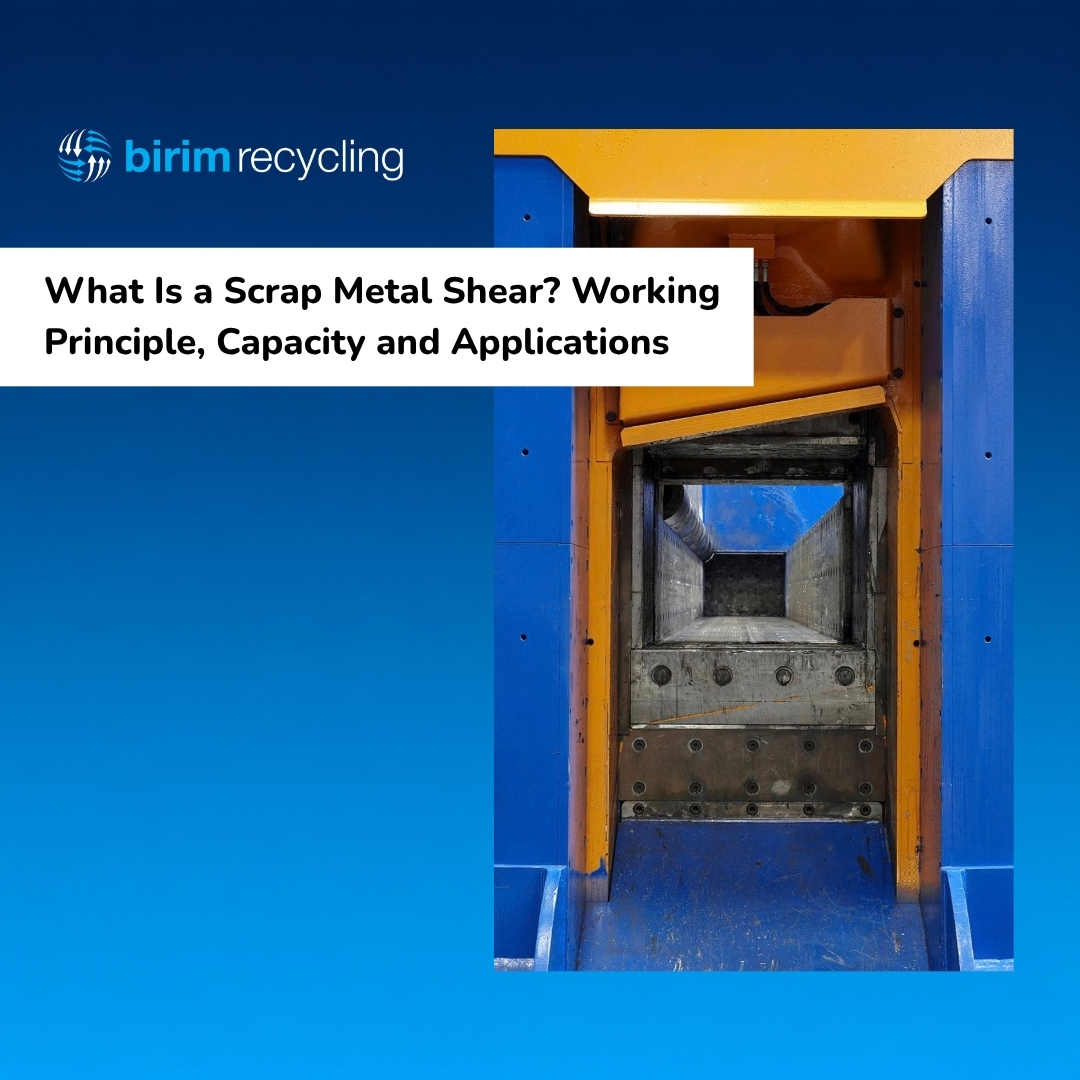
A scrap metal shear is the machine that turns unsorted, oversized scrap into pieces a furnace or a buyer will accept. It sits at the centre of most scrap processing yards, and everything upstream and downstream is usually sized around it.
The name describes only half of what the machine does. Cutting is the visible part. The compression that happens before each cut is what determines capacity, cut quality and how much the machine can handle without stopping.
This article covers the working principle, the materials it handles, how capacity is actually measured, and the main types used in scrap processing.
1 What Is a Scrap Metal Shear?
A scrap metal shear is a hydraulic machine that cuts ferrous and non-ferrous scrap into defined lengths, while compressing it to increase density before the cut is made.
Two outcomes come out of that process, and both matter commercially. The first is size. Steel mills and foundries accept material within a size range their charging equipment and furnace can handle, and oversized scrap either gets rejected or gets priced down. The second is density. Denser material moves more economically and charges more predictably.
This is why Scrap Metal Shears are described in terms of cutting and densification together rather than cutting alone. A machine that cuts without compressing produces correctly sized material at a density the market will discount.
Where the shear sits in the yard. Material arrives and is sorted, a material handler feeds the shear, and the output goes to storage, transport or further processing. Because the shear usually sets the throughput of the whole line, the handling equipment around it is normally specified against its capacity rather than the other way round.
2 How Does a Scrap Metal Shear Work?
The cycle has four stages, and they repeat continuously during operation.
Feeding. Material is loaded into the feeding box, normally by a material handler. Box size determines what can be accepted without pre-cutting, which is why a large feeding box matters for oversized input.
Compression. Before the blade moves, the material is compressed to increase density. On Orca Side Compression Shears this is described as compressing heavy and light scrap to increase density ahead of shearing. Compression does two things at once: it raises the density of the finished piece, and it presents a consistent cross section to the blade instead of a loose, uneven mass.
Shearing. The blade cuts through the compressed material. Cutting length can be selected according to the required output size, so a single machine can produce different piece lengths for different buyers.
Discharge. The cut material leaves the machine and the cycle repeats. Orca is listed at up to five cuts per minute, which gives a sense of how short each cycle is in continuous operation.
Why compression comes before cutting. Cutting loose scrap wastes blade travel on air. Compressing first means each stroke cuts a full cross section, which raises throughput, improves cut consistency and reduces uneven loading on the blade edge.
Supporting systems keep that cycle running. Birim Recycling shears include an advanced oil filtering system, automatic lubrication, non-contact sensors that prevent interruptions from debris, short stroke programming, and remote diagnosis and troubleshooting via modem connection.
3 What Types of Scrap Can Be Processed?
The published material list for Orca Side Compression Shears covers HMS 1, HMS 2, Longs, Pipe, Profiles, Sheet, Shipbreaking Scrap, ELV, Mixed Scrap and Casting. Shark Wing Compression Shears lists HMS 1, HMS 2, Sheet, ELV and Mixed Scrap, along with pipes and both heavy and light scrap.
| Material | What it is | What it demands from the machine |
|---|---|---|
| HMS 1 / HMS 2 | Standard grades of heavy melting steel scrap | Consistent cutting force; the reference material for most capacity figures |
| Longs and Profiles | Beams, bars and structural sections | Feeding box length and cutting length flexibility |
| Sheet | Thin, loose, high-volume material | Compression capability more than cutting force |
| Pipe | Hollow sections that collapse before cutting | Controlled compression to avoid uneven blade loading |
| Shipbreaking Scrap | Heavy plate and section from vessel dismantling | High cutting force and structural strength |
| ELV | End-of-life vehicles | Mixed material handling within one charge |
| Casting | Thick, hard, brittle cast components | Blade toughness and impact resistance |
| Mixed Scrap | Unsorted combinations of the above | Tolerance for variation between consecutive cycles |
Mixed Scrap is the hardest specification to meet, because the machine cannot be optimised for one input. A yard processing mostly mixed material should give the supplier a realistic description of the mix rather than the heaviest item in it.
4 How Is Scrap Shear Capacity Measured?
Capacity is quoted in tons per hour, and the figure is a range rather than a single number for a specific reason.
Orca Side Compression Shears is listed at 20 to 60 tons per hour. Shark Wing Compression Shears is listed at 8 to 30 tons per hour when shearing and 10 to 35 tons per hour when baling. Those ranges reflect what changes between operating conditions, not uncertainty about the machine.
| Variable | Effect on tons per hour |
|---|---|
| Material density on arrival | Loose, light scrap fills the box for less weight per cycle |
| Material hardness and thickness | Harder input needs more force and slows the cycle |
| Required cut length | Shorter pieces mean more cuts for the same tonnage |
| Feeding rate | The shear only processes what the material handler delivers |
| Operating mode | Automatic operation sustains a more consistent cycle than manual |
| Machine condition | Blade and hydraulic condition change achievable output over time |
- Which material is the stated capacity based on?
- What cut length does that figure assume?
- How is the machine fed, and at what rate?
- What tonnage applies to my actual material mix?
A capacity figure becomes comparable between suppliers only once those four answers are attached to it. Without them, two quotations can show the same number and describe different machines.
5 Main Types of Scrap Metal Shears
Shear types are distinguished by how material is compressed before the cut. Birim Recycling produces four configurations.
| Type | Model | Compression principle | Typical use |
|---|---|---|---|
| Side press | Orca Side Compression Shears | Compression applied from the side before shearing | High volume processing of heavy and mixed scrap, 20 to 60 t/h |
| Inclined | Piranha Inclined Shears | Inclined feeding arrangement | Facilities where feeding geometry drives the layout |
| Wing | Shark Wing Compression Shears | Wing compression; also produces bales | Operations needing shearing and baling in one machine |
| Container / box | Murenha Container Shears | Container-style chamber | Contained processing of suitable material types |
Shark Wing Compression Shears is worth noting separately because it shears and bales. For a yard that needs both functions but not two machines, that changes the equipment plan.
Installation format is a second choice that sits alongside type. Orca and Shark are both listed with stationary, mobile and semi-mobile versions, and Shark is available with diesel or electric power. Mobile configurations suit operators working across more than one site or handling material where it arrives.
6 How to Choose the Right Scrap Shear for Your Facility
Five questions narrow the selection quickly.
What is the material mix? Describe it by type and proportion. HMS 1 and HMS 2 with occasional profiles is a different specification from ELV and mixed sheet.
What volume needs processing? Monthly or annual tonnage matters more than a peak day, because a machine sized for the peak sits underused for the rest of the year.
What size does the output need to be? This usually comes from the buyer. Cutting length can be selected as required, so it is worth confirming the range rather than a single value.
Does the site need shearing only, or shearing and baling? If both, a wing compression machine can cover the requirement in one unit.
Stationary or mobile? Single-site operations are usually stationary. Operators working across sites should look at mobile and semi-mobile configurations, and at the power option that suits the locations.
Information to prepare before requesting a quotation
- Material types and approximate proportions
- Monthly or annual tonnage to be processed
- Required output size or size range
- Whether baling is needed alongside shearing
- Site layout, available space and power supply
- Planned feeding method and handling equipment
- Whether the machine needs to move between sites
Choosing a Shear That Matches the Yard
A shear is specified well when the material, the volume and the required output size are defined before the model comparison starts. Capacity ranges then describe what each machine does with a known input, which is the only form in which they can be compared.
Birim Recycling manufactures these machines in side compression, inclined, wing compression and container configurations, with stationary, mobile and semi-mobile versions depending on the model. Sharing your material mix, volume and required output size is usually enough to identify which configurations should be evaluated.
Request a Scrap Metal Shear Assessment
Share your material mix, processing volume and required output size, and Birim Recycling will identify which shear configuration should be evaluated for your facility.
Contact Birim RecyclingQuick Recap
What is a scrap metal shear?
A hydraulic machine that cuts ferrous and non-ferrous scrap into defined lengths while compressing it to increase density before each cut. It produces material that is both correctly sized and denser, which is what steel mills and foundries require.
Why is material compressed before cutting?
Compression raises the density of the finished piece and presents a full, consistent cross section to the blade. Cutting loose scrap wastes blade travel and produces uneven loading on the cutting edge.
Which materials can a shear process?
Published material lists include HMS 1, HMS 2, Longs, Pipe, Profiles, Sheet, Shipbreaking Scrap, ELV, Mixed Scrap and Casting, with the exact list varying by model.
How is scrap shear capacity measured?
In tons per hour, always as a range. Orca Side Compression Shears is listed at 20 to 60 tons per hour, and Shark Wing Compression Shears at 8 to 30 tons per hour shearing and 10 to 35 tons per hour baling. The range reflects material density, hardness, cut length and feeding rate.
What are the main types of shears used in scrap processing?
Side press, inclined, wing and container configurations, distinguished by how material is compressed before the cut. Wing compression machines can also produce bales, which covers two functions in one unit.
Related equipment: Metal Scrap Balers · Material Handlers · Shredder · Service & Spare · About Birim Makina
