
Home › Media › What Is a Briquette Press
Machining produces chips continuously, and most plants handle them the way they arrive: swept into bins, stored in a corner of the yard, loaded loose and sold by weight. The material can be processed in that form. The question is what that form costs along the way.
A briquette press machine changes the shape of the problem rather than the material. It takes loose chips, swarf and sludge and compacts them into dense, stable briquettes, releasing most of the cutting fluid they carry in the process.
This article covers what loose chips cost before briquetting, how the compaction cycle works, what happens to the fluid that comes with the material, why briquette density matters at the furnace, and when a single machine is enough compared with an integrated line.
1 What Loose Chips Cost Before Briquetting
Loose chips are workable material. Plants process and sell them every day without a briquette press. What they are not is efficient, and the inefficiency shows up in four separate places rather than one.
Volume and storage. Chips are mostly air. A given tonnage of loose turnings occupies several times the space of the same tonnage compacted, which means more bins, more floor area and more handling movements for the same weight of material.
Transport. A truck has a weight limit and a volume limit. Loose chips reach the volume limit long before the weight limit, so the vehicle leaves with unused payload. The cost per ton moved rises accordingly, and it rises on every shipment.
Melting loss. Thin, high surface area material oxidises quickly and burns off in the furnace. The scale of this loss depends on the alloy, the chip geometry and how the charge is handled, but the direction is consistent: the looser the material, the more of it is lost as oxide rather than recovered as metal.
Fluid carried away. Chips leaving a machining centre hold cutting fluid and oil. Unless that fluid is separated, it leaves the plant with the scrap. The fluid itself is paid for, and in most operations it is also a waste stream with its own disposal requirement.
The honest framing. Briquetting does not make an impossible material possible. It removes four recurring costs that loose handling accepts as normal. Whether that trade works depends on tonnage, and the calculation is specific to each plant.
| Cost area | Loose chips | After briquetting |
|---|---|---|
| Storage | Large volume for small tonnage | Compacted, stackable units |
| Transport | Volume limit reached before weight limit | Payload used more fully |
| Melting | High surface area, higher oxidation loss | Lower exposed surface per ton charged |
| Cutting fluid | Leaves with the scrap | Separated during compaction |
| Handling | Loose, spills, repeated movements | Discrete units, predictable handling |
2 The Briquetting Cycle, Step by Step
A briquetting press works on a repeating cycle. The sequence is short, and the machine runs it in full automatic operation once the feed is stable.
Feeding. Material enters the machine, usually by conveyor from a collection point or from upstream conditioning equipment. Feed consistency is the single factor that most affects cycle stability, which is why screens and shredders appear ahead of the press in many layouts.
Filling the chamber. A measured charge of material moves into the compaction chamber. The volume entering is far greater than the volume leaving, and the ratio between them varies with the material and its form.
Compaction. The hydraulic system applies pressure and the chamber volume closes down. This is where the fluid separates, where the material locks together, and where the briquette reaches its final density.
Ejection. The finished briquette leaves the chamber and the machine starts the next cycle. Output is a stream of uniform units rather than a continuous extrusion.
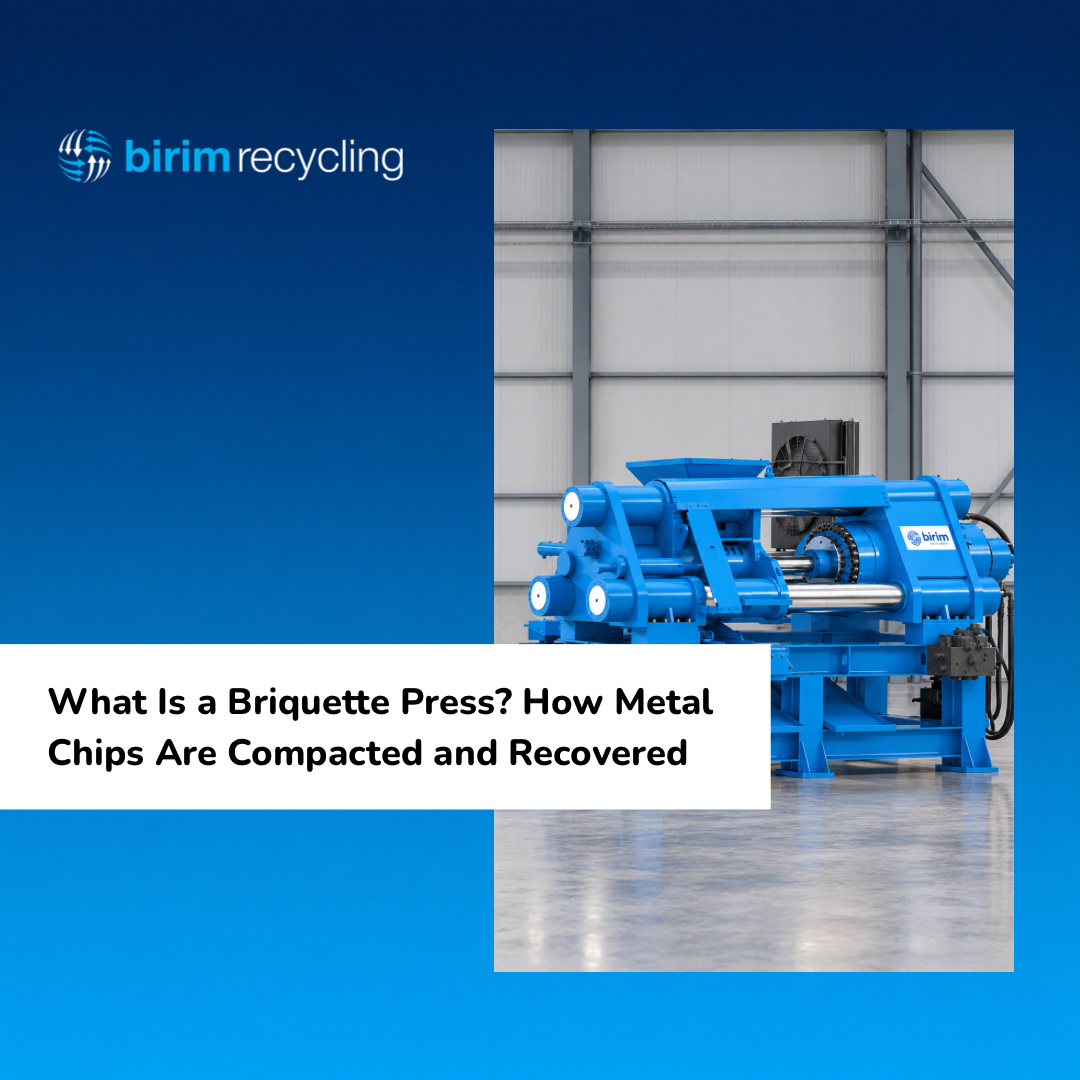
The Birim Recycling briquetting press is listed with a capacity range of 0.5 to 10 tons per hour depending on model, which covers both a single machining shop and a high throughput chip processing plant. Suitable input materials are listed as Steel, Cast Iron, Aluminum, Stainless Steel, Copper and Brass, in the forms of chips, swarf and sludge.
Two structural points matter for anyone running the machine rather than specifying it. Heavy duty cylinders and the hydraulic system are designed and manufactured in house, and tooling and wear parts are designed for quick changes. Both affect how long a planned stop takes rather than how the machine performs on a good day, which is usually where the real difference between machines appears.
Remote diagnosis over a modem connection is also part of the specification. For a plant without an in house hydraulics technician, that often decides whether a fault is a phone call or a site visit.
3 Cutting Fluid and Oil Recovery
Chips arriving from a machining centre are wet. How wet depends on the operation, the fluid system and how long the material has been sitting, and it is the variable that most often gets left out of a briquetting calculation.
Compaction squeezes that fluid out. It drains from the chamber and can be collected rather than shipped out with the scrap. Two things follow from that.
The first is the fluid itself. Depending on the system in use, recovered fluid can be filtered and returned to the machining process, which turns a purchased consumable into a partially recovered one.
The second is the waste side. Fluid that would otherwise leave as part of a wet scrap load stays in the plant as a separated stream, which is usually easier to handle under local waste rules than a saturated chip load.
Sludge is a separate case. Grinding sludge holds far more fluid than dry turnings and behaves differently under pressure. It is listed as a suitable input, but the throughput and the recovered volume will not match the figures for dry chips. If sludge is a meaningful share of your stream, it should be stated separately when asking for a capacity figure.
4 Briquette Density and Melting Yield
Density is the number that connects the press to everything downstream. It decides how much metal sits in a cubic metre, how the briquette behaves in the furnace, and what a shipment costs to move.
The Birim Recycling briquetting press is listed with briquette densities up to 5.5 t/m³ for steel, 2.4 t/m³ for aluminum and 7.8 t/m³ for copper. Those figures are upper values for the material rather than a single guaranteed output, and the density actually reached depends on chip form, moisture and machine settings.
| Material | Briquette density, up to |
|---|---|
| Steel | 5.5 t/m³ |
| Aluminum | 2.4 t/m³ |
| Copper | 7.8 t/m³ |
At the furnace, density works through surface area. A dense briquette presents less exposed metal per ton charged than the same material loose, so less of it oxidises before it melts. It also sinks into the bath rather than floating and burning on the surface, which is the behaviour that makes loose chips difficult to charge in the first place.
In transport, density works through payload. Higher density means more tons in the same loaded volume, so fewer movements for the same tonnage sold or returned to the furnace.
- What briquette density applies to my material and chip form, not the material maximum?
- What capacity figure applies to my material at my moisture level?
- How much fluid is typically recovered from an input like mine?
- Which tooling and wear parts are changed routinely, and how long does a change take?
- What does remote diagnosis cover, and what still requires a site visit?
5 Single Machine or Integrated Line?
A briquetting press can be supplied as a single machine or as part of an integrated plant with screens, shredders and conveyors. Which one fits depends less on tonnage than on how consistent the incoming material is.
A single machine suits a stream that is already reasonably uniform. CNC chips from a known set of operations, collected and fed directly, give the press stable conditions without conditioning equipment ahead of it.
Conditioning becomes necessary when the input varies. Long turnings bridge and stall the feed. Oversize pieces and mixed fractions make the cycle unpredictable. Two machines address those cases.
A shredder reduces long turnings and bulky scrap so material flows rather than bridges. The Birim Recycling scrap shredder is listed with motor power options of 55, 110 and 200 kW, a rotor speed of 1000 rpm, and output up to 18 tons per hour on turnings.
A screen separates oversize pieces and delivers a more uniform fraction, which keeps chamber pressure stable and reduces operator intervention.
| Input | Layout | What it solves |
|---|---|---|
| CNC chips, consistent | Screen → Briquetting press | Densification and fluid recovery with minimal conditioning |
| Long turnings | Shredder → Screen → Briquetting press | Flow problems and bridging at the feed |
| Mixed scrap | Shredder → Conveyors → Screen → Briquetting press | Variable size and composition, stable cycle |
One practical point for plants that expect to grow: a press installed as a single machine can be extended later with a screen, a shredder and conveyors. Starting with the press and adding conditioning when the stream changes is a normal path, and it avoids specifying a full line for a volume that does not yet exist.
What to prepare before requesting a briquetting assessment
- Material types, listed separately rather than as one mixed figure
- Chip form: turnings, fine chips, swarf or sludge, and the rough share of each
- Monthly tonnage, and whether it is steady or seasonal
- Moisture level, and which cutting fluid is in use
- What happens to the briquettes: own furnace, sold, or returned to a supplier
- Available floor space, power supply and planned feeding method
- Whether long turnings or oversize pieces appear in the stream
Where a Briquette Press Earns Its Place
A briquette press machine is specified from the material, not from a capacity figure. Chip type and form set the compaction requirement, moisture sets the recovery expectation, and what happens to the briquette afterwards sets the density target. Tonnage per hour describes what the machine does with that input once the three are known.
For a plant weighing the investment, the comparison is not briquetting against doing nothing. It is the cost of the press against four costs already being paid every month in storage, transport, melting loss and fluid.
Request a Briquetting Assessment
Share your chip types, monthly tonnage and moisture level, and Birim Recycling will identify which briquetting press configuration should be evaluated for your material.
Contact Birim RecyclingQuick Recap
What is a briquette press?
A machine that compacts loose metal chips, swarf and sludge into dense briquettes under hydraulic pressure, separating most of the cutting fluid carried with the material during compaction.
Can metal chips be processed without briquetting?
Yes. Loose chips are sold and melted every day. Briquetting addresses the cost of handling them in that form: storage volume, unused transport payload, oxidation loss at the furnace and cutting fluid leaving with the scrap.
What briquette density can be reached?
The Birim Recycling briquetting press is listed with densities up to 5.5 t/m³ for steel, 2.4 t/m³ for aluminum and 7.8 t/m³ for copper. The density reached in practice depends on chip form, moisture and machine settings.
Which materials can be briquetted?
Steel, cast iron, aluminum, stainless steel, copper and brass, in the forms of chips, swarf and sludge. Sludge holds far more fluid than dry turnings and should be quoted separately.
Is a shredder or screen always needed before the press?
No. A consistent chip stream can feed the press directly. A shredder is added when long turnings cause bridging, and a screen when the fraction varies enough to make the cycle unstable. Both can be added to an existing installation later.
Related equipment: Chip Processing · Metal Scrap Balers · Scrap Metal Shears · Service & Spare · Contact Birim Recycling
