
Home › Media › Shredder Capacity vs Catalogue Figure
A shredder is bought on a tonnage figure and judged on a different one. The gap between them is the most common complaint in scrap size reduction, and it is rarely caused by the machine underperforming.
Catalogue capacity is a correct figure measured under defined conditions. The yard then runs a different material, through a different feed, to a different output size. Throughput moves accordingly.
This article sets out what a capacity figure actually describes, which five variables move it in practice, and what to establish before comparing one supplier's number with another's.
1 What a Capacity Figure Describes
A published capacity is a measurement, not a promise. It records what the machine produced with a stated material, at a stated feed rate, to a stated output size, running continuously.
Three of those four conditions are set by the yard rather than the manufacturer. That is why two plants running the same model can report throughputs that differ by a factor of several, and both be telling the truth.
The useful question is not whether the figure is accurate. It is which figure applies to your material.
A practical test when comparing quotations. Ask which material the quoted tonnage was measured on. If the answer is a range across all materials, the number cannot be compared with another supplier's number. If the answer names a material and an output size, it can.
2 Material Type: The Largest Single Variable
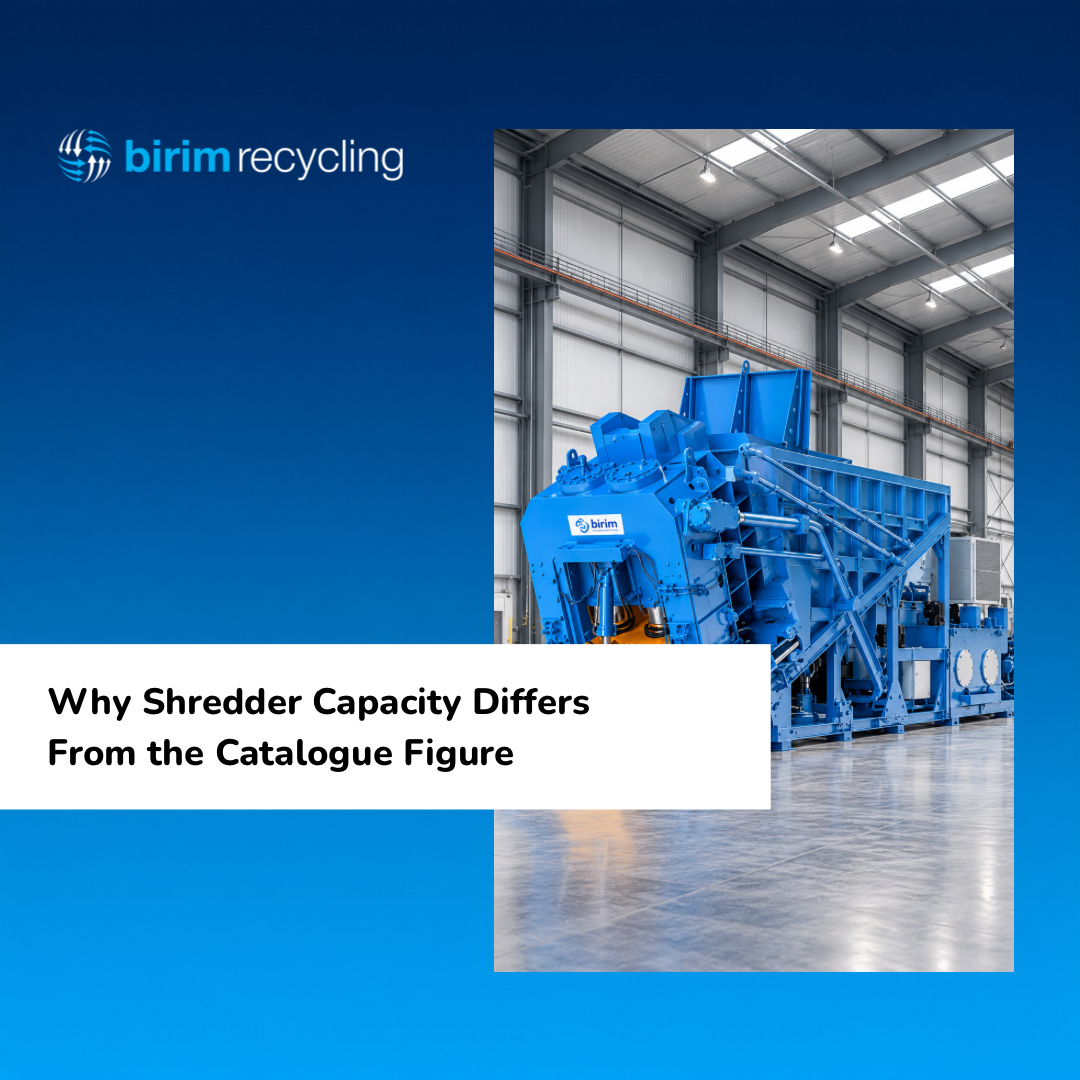
Nothing moves shredder throughput as much as what is being fed into it. The Birim Recycling scrap shredder publishes output capacity by material rather than as one headline figure, which makes the spread visible.
| Material | Output capacity, up to |
|---|---|
| Turnings | 18 tons/hour |
| Castings | 7 tons/hour |
| Aluminum profiles | 4 tons/hour |
| Small white goods | 3.5 tons/hour |
Turnings to small white goods is a fivefold difference on the same machine. Two properties explain most of it.
How the material presents itself to the rotor. Turnings arrive loose and flow into the cutting circle continuously. Castings arrive as discrete solid pieces that have to be reduced one at a time. The rotor turns at the same 1000 rpm in both cases; what changes is how much material each revolution can act on.
Bulk density. Light material fills the chamber volume for a small tonnage. The machine is working, the hopper looks full, and the scale moves slowly. This is why aluminum profiles and small white goods sit at the bottom of the table despite being easy to cut.
The suitable input list across the range covers metal turnings, machining chips, incineration scrap, castings including motors and gearboxes, light aluminum profiles, pressed rolls, and small white goods and tin cans. A yard running a genuine mix should expect a blended throughput somewhere between the published figures, weighted by what actually dominates the stream.
3 Feed Consistency and Input Opening
A shredder reaches its published figure under continuous feeding. Most yards do not feed continuously, and the lost time is usually invisible because it is spread across the shift in short interruptions.
Two causes account for most of it.
Feeding in batches. A machine fed by grab in discrete loads alternates between overload and idle. Neither state produces the rated tonnage. Where the shredder is fed by conveyor at a controlled rate, throughput moves much closer to the published figure, which is the main reason conveyors appear in chip processing layouts.
Oversize pieces at the opening. A piece that does not fit has to be removed or cut before work continues. The Birim Recycling shredder is listed with input area sizes from 730×795 mm up to 1420×1230 mm, and rotor dimensions from 890 to 1125 mm in diameter and 730 to 1420 mm in length. Whether your material clears the opening on the selected model is a question to settle before capacity is discussed, not after.
Long turnings deserve a separate mention. They bridge above the rotor and stall the feed, which is the specific problem upstream size reduction exists to solve. In a chip processing line the shredder plays that role ahead of the briquetting press; where the shredder itself is receiving long material, the same logic applies one step earlier.
4 Moisture, Contaminants and Unshreddables
Wet material behaves differently from dry material of the same type. Chips and turnings carrying cutting fluid pack together rather than flowing, and packed material feeds unevenly. The effect is most visible on turnings, which is also the material with the highest published figure and therefore the most to lose.
Contaminants cost throughput in a different way. Dirt and falling scrap around sensors cause stoppages that have nothing to do with cutting. The machines in the Birim Recycling range use non-contact sensors specifically to reduce interruptions from that source, and an advanced oil filtering system and automatic lubrication for the same reason: the aim is fewer unplanned stops rather than a higher peak rate.
Unshreddable items are the expensive case. A piece that cannot be cut stops the machine, requires the rotor to be cleared, and takes the line down for as long as access takes. The tiltable upper body on the Birim Recycling shredder exists to shorten that access, and the reversible rotor extends hammer life so the planned stops come round less often.
Where the hours actually go. Most of the distance between catalogue capacity and monthly tonnage is unplanned stoppage, not a slower cutting rate. A machine that cuts 10 percent slower but stops half as often will out-produce the faster one over a month.
5 Target Output Size and Comparing Suppliers
Output size is the variable buyers most often leave undefined, and it works directly against throughput. A smaller target piece size means more reduction per unit of material, which means more time in the cutting circle and a lower tonnage per hour.
The size that matters is the one the next step needs. If the shredded material goes to a briquetting press, the requirement is whatever feeds that press without bridging. If it goes to a furnace, the requirement is what charges cleanly. If it is sold, the buyer sets it. Specifying a smaller size than the next step needs costs throughput and buys nothing.
Motor power is where the three variables meet. The range is listed with 55, 110 and 200 kW options, and machine weight from 8 to 34 tons depending on model. A heavier material, a larger input opening and a smaller output size all push the selection up that range rather than being absorbed by the same machine.
- Which material was the quoted capacity measured on, and at what output size?
- What figure applies to my material mix rather than to a single clean stream?
- Was the figure measured under continuous feeding, and what feed arrangement does that assume?
- Will my largest regular piece clear the input opening on the proposed model?
- How long does clearing the rotor take after an unshreddable item?
What to prepare before requesting a shredder capacity figure
- Material types and the rough share of each in the stream
- Largest regular piece dimensions, and how often oversize material appears
- Whether turnings are long or short, and whether they arrive wet
- Planned feeding method: grab, conveyor or hopper
- Required output size, and what set it
- Monthly tonnage rather than a peak hour
- Shift pattern and the power supply available
Reading a Capacity Figure Correctly
A catalogue figure is the starting point of a conversation, not the end of one. It tells you what the machine can do under good conditions with a defined material, and the work of specification is establishing how far your conditions sit from those.
Stated the other way round: a supplier who gives one number for every material is giving you less information, not more. The published figures for the Birim Recycling shredder separate turnings, castings, aluminum profiles and small white goods precisely because those four cannot share a number.
Request a Shredder Capacity Assessment
Share your material mix, largest regular piece size and required output size, and Birim Recycling will indicate which shredder configuration applies and what throughput to expect from it.
Contact Birim RecyclingQuick Recap
Why does a shredder not reach its catalogue capacity?
Because the catalogue figure was measured on a defined material, at a defined feed rate, to a defined output size. Change any of those and throughput changes. Most of the gap in practice is unplanned stoppage rather than a slower cutting rate.
How much does material type change shredder throughput?
On the Birim Recycling shredder the published figures run from up to 18 tons per hour on turnings down to 3.5 tons per hour on small white goods. That is a fivefold spread on the same machine.
Does feeding method affect capacity?
Yes. Published figures assume continuous feeding. A machine fed in batches by grab alternates between overload and idle, and neither state produces the rated tonnage.
Why does output size matter for throughput?
A smaller target piece size means more reduction per unit of material and therefore a lower tonnage per hour. The size to specify is whatever the next step needs, whether that is a briquetting press, a furnace or a buyer.
What should be checked before capacity is even discussed?
Whether the largest regular piece clears the input opening. The Birim Recycling shredder is listed with input areas from 730×795 mm up to 1420×1230 mm, so this is a model selection question rather than an operating one.
Related equipment: Chip Processing · Scrap Metal Shears · Metal Scrap Balers · Service & Spare · Contact Birim Recycling
