
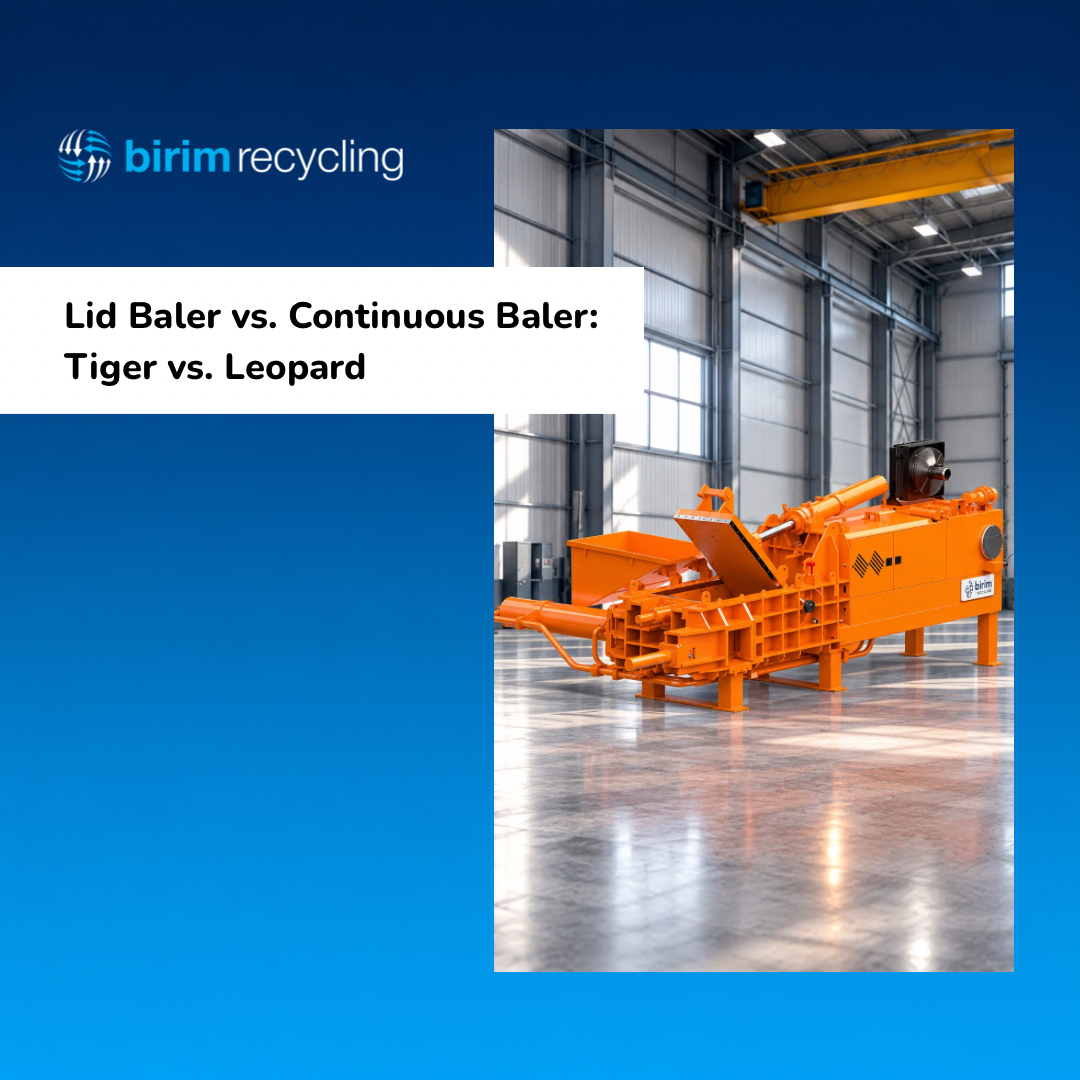
Tiger 3 Ram Lid Baler and Leopard Continuous Baler produce bales in the same size range, from 25×25 to 60×60 cm. On a specification sheet they can look interchangeable.
They are not. The difference between a lid baler and a continuous baler sits in how material enters the chamber, and that single distinction sets capacity, cycle time, feeding requirements and how much the operation around the machine has to be organised.
This comparison works through both principles, then places the two models side by side on the figures that actually decide a lid baler vs continuous baler choice.
1 What Is a Lid Baler?
A lid baler works in batches. The charging box is loaded from above while open, a lid then closes over the chamber, and compression follows in sequence until the bale is formed and ejected.
The lid is what makes the batch structure necessary. It has to close before compression starts, which means loading and compressing take turns rather than overlapping. Each bale is a complete cycle: load, close, compress, eject, open again.
That structure has a practical advantage. Because the box is open and unobstructed during loading, bulky and awkward material can be dropped in without being fed through a narrower opening. Long profiles, large sheet and irregular pieces are easier to place.
The trade-off is the pause. Nothing is compressed while the box is being loaded, and nothing is loaded while the lid is closed. On a site where material arrives in batches rather than a steady stream, that pause costs nothing, because the machine would be waiting anyway.
2 What Is a Continuous Baler?
A continuous baler removes the lid cycle. Material is fed into the chamber without waiting for a lid to close, and compression runs as a continuous sequence rather than a series of separate batches.
Removing the pause is what raises sustained throughput. The machine is compressing for a larger share of the hour, so the same installed power produces more tonnage across a shift.
That capability comes with a requirement. A continuous baler only performs continuously if it is fed continuously, which means the material handler, hopper and conveyor arrangement around it has to keep up. A continuous machine fed in batches behaves much like a batch machine, and the investment in the difference goes unused.
The distinction that matters in practice. A lid baler is limited by its own cycle. A continuous baler is limited by whatever feeds it. Deciding between a lid baler and a continuous baler is usually a question about the yard rather than about the press.
3 Tiger Lid Baler: How Does It Work?
Tiger 3 Ram Lid Baler is a baling press with three compression stages, operating on the lid principle described above.
Published figures place its capacity at 1 to 40 tons per hour, with bale sizes from 25×25 to 60×60 cm and high density bales. It is listed with automatic and manual operation, and its hopper is described as reducing scrap feeding time.
The capacity range is worth reading carefully. A lower limit of 1 ton per hour indicates a machine that works sensibly at low volumes, which a continuous machine sized for high throughput does not. For a yard processing modest tonnage, or tonnage that varies considerably month to month, that lower end is a real advantage rather than a footnote.
Manual operation matters for the same reason. Where material varies enough that an operator needs to judge each charge, having manual mode available is more useful than an automatic cycle that assumes consistent input.
4 Leopard Continuous Baler: How Does It Work?
Leopard Continuous Baler is also a three ram design, built for continuous operation.
Its capacity is listed at 6 to 65 tons per hour, with a fast operation cycle of up to 25 seconds. Bale sizes match Tiger at 25×25 to 60×60 cm, also producing high density bales. It is listed with full automatic and semi automatic operation, and with low energy consumption attributed to its hydraulic system.
One design detail is specific to this model. The third and final compression ram is longer than the size of the chamber, which is what allows the bale to be completed and discharged within the continuous sequence rather than requiring a separate ejection stage.
Leopard can also work as a single machine or as an integrated plant with loading hoppers and conveyors. That option is the clearest signal of where the model belongs: it is designed to sit inside a feeding system, not beside one.
5 Tiger vs. Leopard: Key Technical Differences
| Specification | Tiger 3 Ram Lid Baler | Leopard Continuous Baler |
|---|---|---|
| Working principle | Lid baler, batch cycle | Continuous baler |
| Capacity | 1 to 40 tons per hour | 6 to 65 tons per hour |
| Cycle time | Set by the lid and compression sequence | Up to 25 seconds |
| Bale size | 25×25 to 60×60 cm | 25×25 to 60×60 cm |
| Bale density | High density | High density |
| Compression | 3 compression stages | 3 ram design, final ram longer than the chamber |
| Operating modes | Automatic and manual | Full automatic and semi automatic |
| Plant integration | Hopper feeding | Single machine or integrated plant with hoppers and conveyors |
| Materials | Steel, Aluminum, Stainless Steel, Copper and Brass as Sheets, Car parts, Profiles, Mixed Scrap, Chips, Cables, Cans and Wires | |
Three lines in that table carry most of the decision.
The capacity floor. Tiger starts at 1 ton per hour, Leopard at 6. A yard whose realistic average sits below the higher figure will not use what it paid for.
The capacity ceiling. Leopard reaches 65 tons per hour against Tiger’s 40. Above 40 tons per hour the comparison ends, because only one machine covers the requirement.
Plant integration. Leopard is offered as part of an integrated plant. Where the plan is a baling line rather than a baling machine, that changes the scope of the project.
Bale size does not decide anything here. Both models cover 25×25 to 60×60 cm, so a yard choosing on bale size alone is comparing identical figures.
6 Which Baler Suits Your Scrap Type and Capacity?
Both models process the same materials: Steel, Aluminum, Stainless Steel, Copper and Brass, in forms including Sheets, Car parts, Profiles, Mixed Scrap, Chips, Cables, Cans and Wires. Material type alone does not separate them, which surprises buyers who expect it to.
In a lid baler vs continuous baler comparison, what separates them is how that material arrives.
| Situation in the yard | Better suited | Why |
|---|---|---|
| Under 40 tons per hour, variable volume | Tiger | Capacity range starts at 1 ton per hour and tolerates fluctuation |
| Sustained volume above 40 tons per hour | Leopard | Only model of the two reaching 65 tons per hour |
| Material arrives in batches | Tiger | Batch cycle matches batch delivery; no idle continuous capacity |
| Steady feed from handler or conveyor | Leopard | Continuous operation uses a continuous supply |
| Bulky, irregular, oversized input | Tiger | Open charging box accepts awkward pieces directly |
| Consistent, sorted material | Leopard | Automatic cycle performs best on predictable input |
| Operator judgement needed per charge | Tiger | Manual operation is listed for this model |
| Planned baling line with conveyors | Leopard | Offered as an integrated plant configuration |
The mistake worth avoiding. Sizing a baler against the busiest week of the year rather than the annual average. A continuous machine that spends most of the year waiting for material costs more to buy and returns less than a batch machine matched to the real workload.
7 How to Choose Between a Lid Baler and a Continuous Baler
Four questions settle a lid baler vs continuous baler decision in most cases.
What is the realistic average tonnage per hour? Not the peak. If the honest answer sits below 6 tons per hour, the continuous option is oversized. Above 40, it is the only option of the two.
Can the yard feed continuously? This depends on material handler availability, hopper and conveyor arrangement, and whether material arrives steadily or in loads. A continuous baler fed in batches performs like a batch machine.
How consistent is the input? Sorted, predictable material suits automatic operation. Material that varies enough to need operator judgement per charge suits a machine with manual mode available.
Is this a machine or a line? If conveyors and hoppers are part of the plan now or later, the integrated plant option should be part of the conversation from the start rather than added afterwards.
- What tonnage per hour applies to my specific material, not the full range?
- What feeding rate does the stated capacity assume?
- What is included in full automatic, semi automatic and manual operation on this model?
- Can the machine be integrated with conveyors and hoppers later?
- What bale density can be expected for my input material?
Information to prepare before comparing the two
- Average and peak tonnage per hour, stated separately
- How material arrives: steady feed or batch delivery
- Material types and forms, with the dominant stream identified
- Required bale size and any density specified by the material buyer
- Available space, power supply and planned feeding equipment
- Whether a baling line is planned now or later
Deciding Between a Lid Baler and a Continuous Baler
The lid baler vs continuous baler decision is not a question of which machine is better built. Tiger 3 Ram Lid Baler and Leopard Continuous Baler produce the same bale sizes at high density, from the same materials, using three compression stages. They differ in how material enters the chamber, and therefore in what kind of operation each one fits.
Tiger suits variable volumes, batch delivery and bulky input. Leopard suits sustained high tonnage with a feeding system to match. The yard decides, not the specification sheet.
Compare Tiger and Leopard for Your Operation
Share your average tonnage, how material arrives and your required bale size, and Birim Recycling will identify which baling principle should be evaluated for your yard.
Contact Birim RecyclingQuick Recap
What is the difference in a lid baler vs continuous baler comparison?
A lid baler works in batches: the box is loaded while open, a lid closes, then compression follows. A continuous baler removes that lid cycle and compresses as material is fed, which raises sustained throughput when the feed can keep up.
How do Tiger and Leopard compare on capacity?
Tiger 3 Ram Lid Baler is listed at 1 to 40 tons per hour and Leopard Continuous Baler at 6 to 65 tons per hour with a cycle of up to 25 seconds. Tiger covers lower and more variable volumes, Leopard covers sustained high tonnage.
Do Tiger and Leopard produce different bale sizes?
No. Both are listed from 25×25 to 60×60 cm with high density bales, so bale size does not separate the two models.
Does a continuous baler always process more material?
Only when it is fed continuously. A continuous baler is limited by whatever supplies it, so on a site where material arrives in batches it performs much like a batch machine.
Which model suits a planned baling line rather than a single machine?
Leopard Continuous Baler, which is offered either as a single machine or as an integrated plant with loading hoppers and conveyors.
Related equipment: Scrap Metal Shears · Material Handlers · Shredder · Service & Spare · Contact Birim Recycling
