
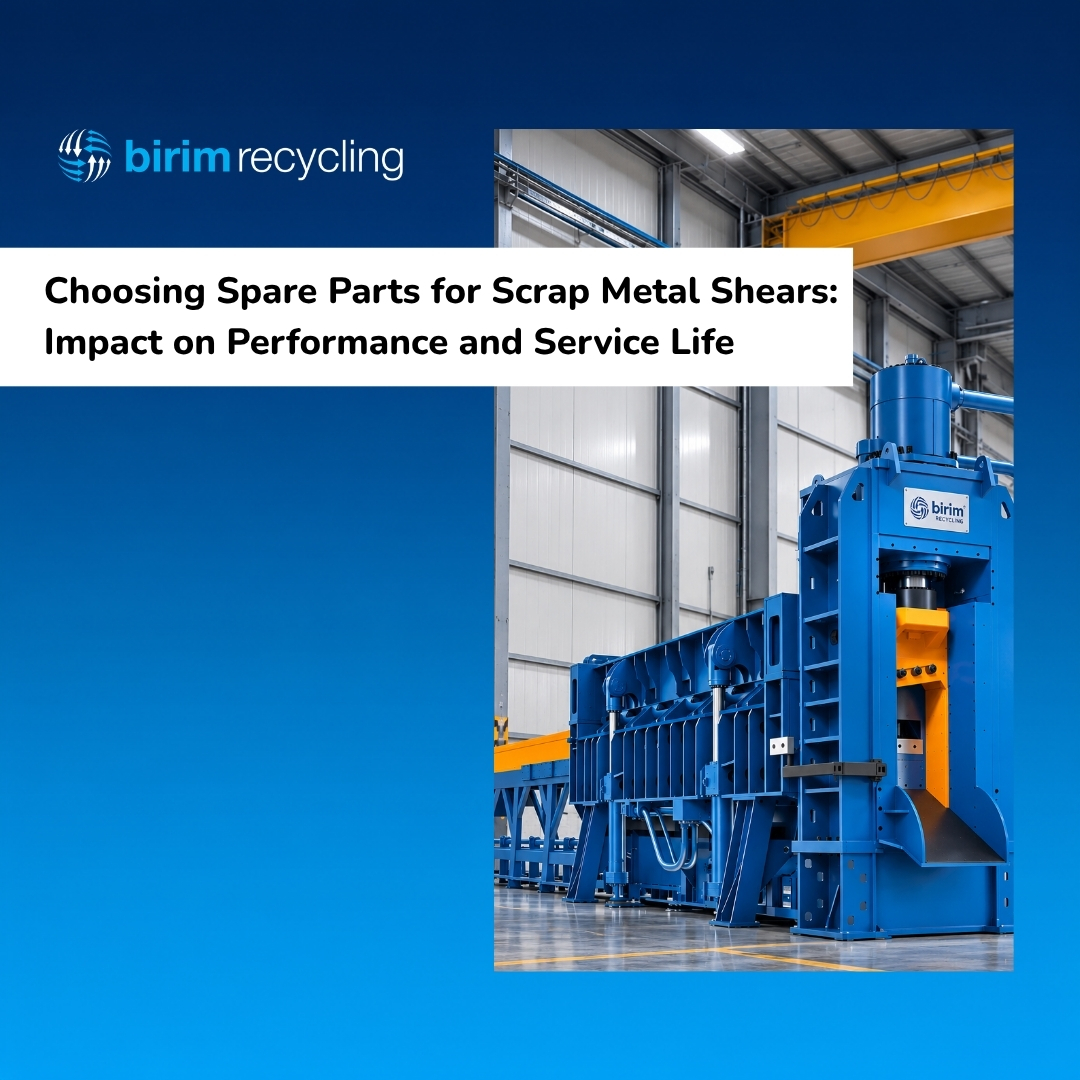
A scrap shear works under conditions that few other production machines face. Every cut puts the blade against mixed, unsorted and often unpredictable material, and the parts that absorb that load decide how long the rest of the machine keeps performing as designed.
Scrap shear spare parts are usually treated as a maintenance line item. In practice they are closer to a performance decision. A blade that holds its edge keeps cut quality stable. A wear plate that resists deformation protects the structure behind it. A seal that fails early can take a cylinder with it.
This article looks at which components of a scrap shear are subject to wear, what to check before ordering replacements, and how the wrong part shows up later as lost throughput and unplanned downtime.
1 Which Parts of a Scrap Shear Are Subject to Wear?
Not every component of a scrap shear wears at the same rate. Some are consumed by direct contact with the material, some degrade through pressure cycles, and some fail because of contamination rather than load.
Birim Recycling’s Service & Spare range covers the components most often replaced on scrap processing machines: Cylinders, Wear plates, Filters, Sensors, Seals, Blades and Hydraulic Valves. Grouping them by why they wear makes replacement planning easier.
| Component | What causes wear | What it affects when worn |
|---|---|---|
| Blades | Direct shearing contact with mixed scrap | Cut quality, cutting force demand, cycle time |
| Wear plates | Abrasion and impact inside the feeding box and compression area | Structural protection, material flow, compression efficiency |
| Cylinders | Pressure cycles, side loading, contamination | Compression and cutting force, stroke consistency |
| Seals | Heat, pressure cycling, particle contamination | Internal leakage, pressure loss, oil consumption |
| Hydraulic valves | Contaminated oil, continuous switching | Response time, sequence accuracy, cycle repeatability |
| Filters | Service life by design; they collect what would otherwise circulate | Oil cleanliness, and through it the life of every other hydraulic part |
| Sensors | Dust, vibration, impact, temperature | Position accuracy, automatic operation, fault reporting |
Filters and seals sit at the bottom of that list in cost and at the top in consequence. They are among the least expensive parts on the machine and the ones most likely to cause an expensive failure when neglected.
2 Why Spare Part Quality Matters in Heavy-Duty Shearing
Scrap is not a controlled input. A machine built to Orca Side Compression Shears specifications processes HMS 1, HMS 2, Longs, Pipe, Profiles, Sheet, Shipbreaking Scrap, ELV, Mixed Scrap and Casting. Those materials differ in thickness, hardness, shape and how they behave under compression.
Published capacity figures assume the machine is in the condition it was designed for. Orca is listed at 20 to 60 tons per hour, and Shark Wing Compression Shears at 8 to 30 tons per hour when shearing and 10 to 35 tons per hour when baling. Those ranges already reflect the variation in scrap type. They do not include an allowance for worn blades or degraded hydraulics.
This is where part quality becomes a throughput question rather than a maintenance one. A dull blade increases the force needed per cut. Higher force means higher pressure, more heat in the oil and more stress on cylinders and seals. The machine keeps running, output drops quietly, and the cost appears somewhere other than the spare parts invoice.
A practical reference point. Birim Recycling designs and manufactures the heavy duty cylinders and hydraulic systems used in its shears. When a replacement part is specified, matching the original level of material grade and build quality is what keeps the published performance figures achievable.
3 Blades and Wear Plates: What Should You Look For?
Blades and wear plates are the two parts operators notice first, and they are evaluated differently.
Blades
Blade performance comes from the combination of material grade, heat treatment and the clearance at which the blade is set. A blade made from the correct grade but mounted with incorrect clearance will chip at the edge rather than cut cleanly. A blade set correctly but produced from a softer grade will round off instead of chipping. Both look like the same problem in the scrap yard, and they have different causes.
Before ordering, confirm the blade dimensions and mounting arrangement for the specific model. Piranha Inclined Shears, Murenha Container Shears and the side and wing compression models do not share a single blade specification. Ask which cutting edges can be rotated before a blade is replaced entirely, since this affects the real cost per operating hour more than the unit price does.
Wear plates
Wear plates protect the box and compression surfaces from abrasion. Birim Recycling uses premium wear plates in its machines, and replacements should be specified by grade and thickness rather than by appearance. A plate that looks similar but has lower hardness will wear through sooner and expose the structure underneath, which turns a plate replacement into a structural repair.
- Which material grade and thickness is this plate, and does it match the original specification?
- How many cutting edges does this blade have, and can it be rotated?
- What blade clearance is specified for this model?
- Are mounting bolts and shims supplied with the part or ordered separately?
4 Hydraulic Components and Their Impact on Performance
The hydraulic system is what turns installed power into cutting force. When it degrades, the symptoms rarely point directly at the cause.
Slower cycle times, inconsistent stroke length and rising oil temperature are usually read as a sign that the machine is getting old. More often they come from internal leakage past worn seals, a valve responding slowly because of contaminated oil, or a filter that passed its service interval and is now in bypass.
Oil cleanliness deserves particular attention on scrap equipment. Birim Recycling shears include an advanced oil filtering system and automatic lubrication for this reason. A filter element is one of the least expensive parts in the spare parts list, and the one whose neglect is most reliably followed by cylinder, valve and pump damage.
| What the operator sees | Where to look first |
|---|---|
| Cycle time increasing gradually | Internal seal leakage, filter condition, oil viscosity |
| Oil temperature rising | Pressure loss across worn components, cooling and filtration |
| Stroke not repeating consistently | Valve response, sensor position, cylinder condition |
| Visible external leakage | Seal condition, rod surface damage, mounting alignment |
| Automatic mode interrupted | Non-contact sensors, wiring, control components |
Several Birim Recycling models support remote diagnosis and troubleshooting via modem connection. Where that capability is fitted, it shortens the step between noticing a symptom and identifying which part to order, which is often the longest part of an unplanned stop.
5 How Incorrect Spare Parts Can Increase Downtime
An incorrect part rarely stops a machine on the day it is fitted. It usually works, then causes a second failure that costs more than the part it replaced.
Four patterns account for most of these cases:
Dimensional mismatch. A blade or plate that is close but not identical can be forced into position. The load then sits where it was not designed to sit, and the mounting surface takes damage that a correctly specified part would have prevented.
Wrong material grade. Hardness and toughness are specified together for a reason. A harder part is not automatically better, since a blade that resists abrasion but lacks toughness will crack under impact from heavy Mixed Scrap or Casting.
Wrong seal compound. Seals are selected for the oil, the pressure and the operating temperature. A seal with the correct dimensions but the wrong compound can swell, harden or extrude, and the resulting contamination spreads through the circuit.
Wrong filtration rating. A filter that fits the housing but filters at a coarser rating allows particles through to valves and cylinders. The damage accumulates across several hundred operating hours before anything visible happens.
The cost that is easy to miss. Downtime on a scrap shear is not only the repair. It is the material already in the yard waiting to be processed, and the throughput that was scheduled against that machine for the week. Measured against that figure, the price difference between a correct part and an approximate one is rarely the deciding factor.
6 How to Choose the Right Spare Parts for Your Scrap Shear
Ordering the right part is mostly a question of identifying it correctly and planning before it is urgent.
Start with the machine itself. Model, serial number and configuration determine which parts apply, and configuration matters because stationary, mobile and semi-mobile versions of the same model are not identical. Where a machine has been modified or fitted with optional equipment, that should be stated when the request is made.
Then separate the parts you should hold in stock from the ones you can order when needed. Filters, seals and sensors are low in value and high in consequence, which makes them worth keeping on site. Blades and wear plates follow a predictable replacement interval once a yard has enough operating history to measure it. Cylinders and valves are usually ordered against a specific need.
Supplier capability is the third factor. Birim Recycling supplies spare parts for its own machines and for other scrap processing machines, with separate contact channels for Spare Parts Requests and for Service Requests and Technical Support, handled for domestic and international projects. For yards operating equipment from more than one manufacturer, a single supplier that covers both reduces the number of open conversations during a breakdown.
Before you place a spare parts order
- Identify the machine model, serial number and configuration
- Describe the symptom, not only the part you assume has failed
- Confirm material grade and dimensions against the original specification
- Ask whether related parts should be replaced in the same intervention
- Check which consumables are worth holding in stock at your site
- Confirm lead time and whether remote support can narrow the diagnosis first
What Scrap Shear Spare Parts Mean for Long-Term Performance
A scrap shear holds its output when the parts carrying the load are in the condition the design assumed. That applies to the blade edge doing the cutting, the wear plate protecting the box, and the filter keeping the oil clean enough for everything downstream.
Birim Recycling manufactures Scrap Metal Shears in side compression, inclined, wing compression and container configurations, and supplies scrap shear spare parts for these machines as well as for other scrap processing equipment. Sharing your machine details and the symptom you are seeing is usually enough to identify which parts should be considered.
Request Scrap Shear Spare Parts
Share your machine model, serial number and the symptom you are seeing. Birim Recycling will identify which parts should be considered, for its own machines and for other scrap processing equipment.
Service & Spare PartsQuick Recap
Which parts of a scrap shear wear out fastest?
Blades and wear plates wear from direct contact with the scrap, while seals, filters and sensors degrade through pressure cycles, contamination and the working environment. Blades and wear plates are usually replaced on a predictable interval, and filters and seals are replaced on a service schedule.
Does spare part quality affect the capacity of a scrap shear?
Yes. Published capacity figures assume the machine is in its designed condition. A dull blade raises the cutting force required, which raises pressure and oil temperature and reduces throughput without stopping the machine.
How should wear plates be specified when ordering?
By material grade and thickness, not by appearance. A plate with lower hardness wears through sooner and exposes the structure behind it, which turns a plate replacement into a structural repair.
Which spare parts should be kept in stock at the site?
Filters, seals and sensors are low in cost and high in consequence, so they are worth holding on site. Blades and wear plates can be planned once the yard has enough operating history. Cylinders and valves are usually ordered against a specific need.
Does Birim Recycling supply spare parts for other brands of scrap processing machines?
Yes. Birim Recycling supplies spare parts for its own machines and for other scrap processing machines, with separate contact channels for spare parts requests and for service and technical support, for domestic and international projects.
Related equipment: Metal Scrap Balers · Material Handlers · Shredder · Chip Processing · Contact Birim Recycling
