
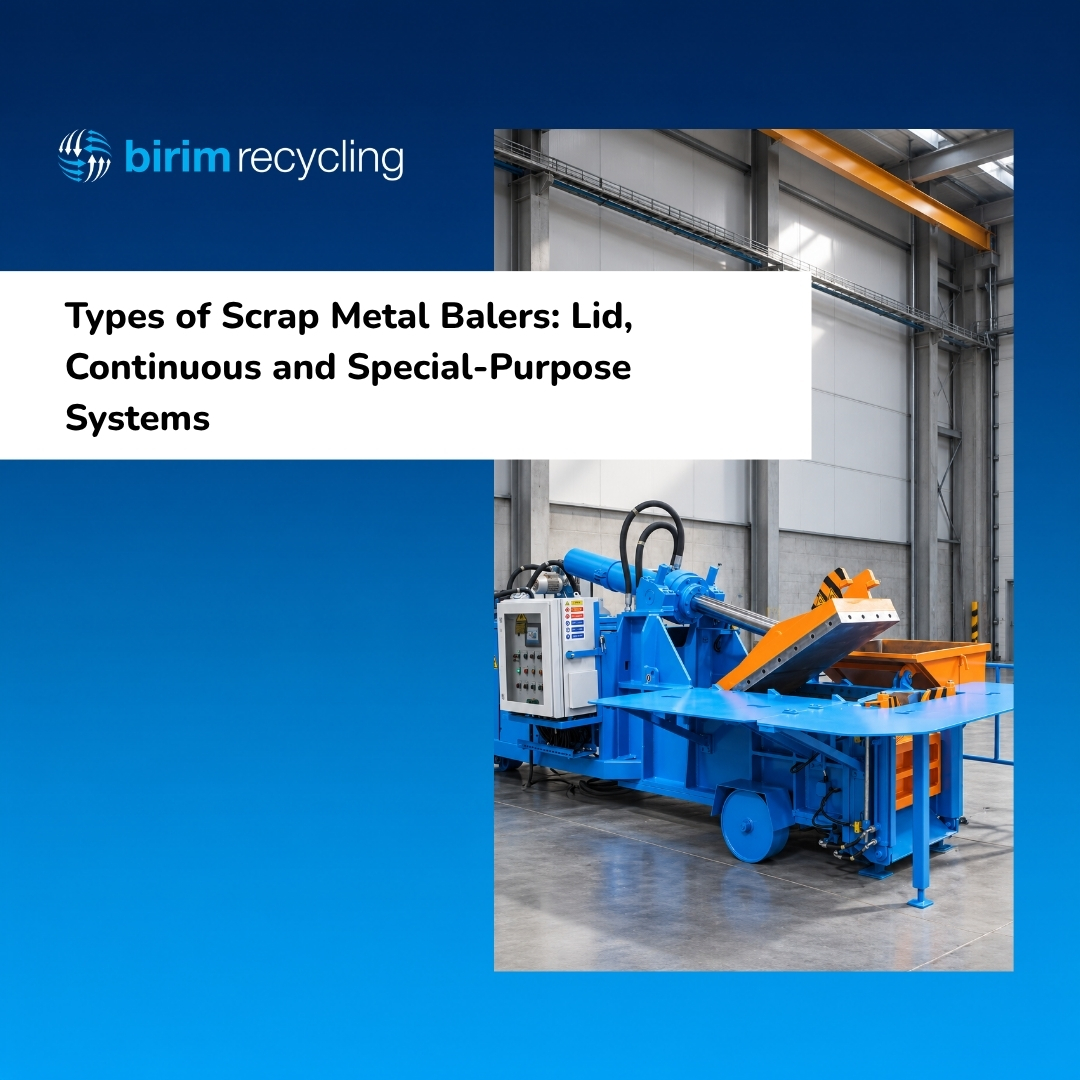
Scrap metal can reach a recycling facility in very different forms, from sheets, profiles and mixed scrap to car bodies and used beverage cans. These differences affect not only how the material is handled, but also what is required from the baling process. A system suitable for one type of operation may therefore not be the right starting point for another.
This is why Scrap Balers are available in different configurations. Lid balers, continuous balers and special-purpose systems approach scrap processing in different ways, with differences in suitable input materials, feeding arrangements, operating modes and processing capacity. Understanding these distinctions is essential when narrowing down the available options.
This article compares the main types of Scrap Balers and explains the differences between lid, continuous and special-purpose systems.
1 What Is a Scrap Metal Baler?
A scrap metal baler compresses loose metal scrap into bales. Although this basic function is common across Scrap Balers, the process can be carried out through different machine configurations depending on the input material and operating needs.
The material itself is one of the first distinctions to consider. Birim Recycling’s baler range includes machines suitable for materials such as Steel, Aluminum, Stainless Steel, Copper and Brass in forms including Sheets, Car parts, Profiles, Mixed Scrap, Chips, Cables, Cans and Wires. Other balers within the range are developed for more specific inputs, such as car bodies or UBC (Used Beverage Can).
The term “scrap metal baler” therefore covers machines with different compression, feeding and operating arrangements. Defining the material and its form provides the first step toward understanding which baler type should be considered. Processing capacity, feeding method and the planned operation can then be used to narrow the choice further.
2 Lid Balers: How They Work and Where They Are Used
Lid balers use a lid as part of the compression process, with additional compression depending on the machine design. This distinguishes them from continuous systems and makes the specific compression arrangement an important part of comparing different baler configurations.
Within Birim Recycling’s range, the Tiger 3 Ram Lid Baler is designed with 3 compression, while the Puma 2 Ram Baler uses 2 compression. Both are suitable for a broad range of materials, including Steel, Aluminum, Stainless Steel, Copper and Brass in forms such as Sheets, Car parts, Profiles, Mixed Scrap, Chips, Cables, Cans and Wires. Both models are also listed with automatic and manual operation.
| Model | Compression | Feeding | Operating Mode |
|---|---|---|---|
| Tiger 3 Ram Lid Baler | 3 compression | Hopper | Automatic / Manual |
| Puma 2 Ram Baler | 2 compression | Optional hopper | Automatic / Manual |
Their feeding arrangements are not identical. Tiger uses a hopper for scrap feeding, while a hopper is listed as optional for Puma. These differences show why Scrap Balers with different compression and feeding arrangements should be examined model by model rather than treated as machines with identical operating characteristics.
Key comparison point. For a facility considering a lid baler, the comparison should therefore begin with the scrap being processed and continue with the compression arrangement, feeding method and required bale output.
Tiger provides a 3 Ram Lid Baler configuration, while Puma offers a 2 Ram Baler configuration for a similarly broad range of suitable input materials.
3 Continuous Balers: Advantages for High-Volume Operations
As processing volume increases, feeding and processing capacity become increasingly relevant to the overall operation. Continuous Scrap Balers use a different operating configuration from lid balers, making feeding arrangement and processing capacity important factors when comparing the two systems.
Birim Recycling’s Leopard Continuous Baler is suitable for Steel, Aluminum, Stainless Steel, Copper and Brass in forms including Sheets, Car parts, Profiles, Mixed Scrap, Chips, Cables, Cans and Wires. Birim Recycling lists a capacity of 6–65 tons/hour and a fast operation cycle of up to 25 seconds for Leopard.
Leopard Continuous Baler: 6–65 tons/hour capacity, operation cycle of up to 25 seconds, full automatic and semi automatic operation.
The machine provides full automatic and semi automatic operation and can work either as a single machine or as part of an integrated plant with loading hoppers and conveyors. For higher-volume applications, these characteristics allow the feeding arrangement, operating mode and required processing capacity to be considered together rather than as separate machine specifications.
- Consider the type of scrap being processed.
- Consider how the machine will be fed.
- Check the operating conditions behind the stated capacity.
A high capacity figure, however, should not be considered independently from the conditions under which it applies. When comparing continuous Scrap Balers, the type of scrap, the way the machine will be fed and the relevant operating conditions should be considered alongside the stated capacity. This provides a clearer basis for determining whether a continuous system matches the intended operation.
4 Special-Purpose Balers: Car and Can Balers
Some scrap processing operations are built around a much more clearly defined input. Instead of handling a broad mix of material forms, the facility may need a baling system for a particular type of scrap or application. This is where special-purpose Scrap Balers become relevant.
Birim Recycling’s Car Baler is listed for Steel and Aluminum in forms including Car Bodies, Sheets and Mixed Scrap. Its suitable input materials therefore reflect a more specific application than balers designed to accommodate a wider variety of scrap forms.
The Can Baler has an even more clearly defined input. Birim Recycling lists UBC (Used Beverage Can) as its suitable input material. The machine provides automatic operation, while its operation information also specifies automatic feeding by magnetic separator conveyor.
| Baler | Suitable Input | Application |
|---|---|---|
| Car Baler | Steel, Aluminum | Car Bodies, Sheets, Mixed Scrap |
| Can Baler | UBC | Used Beverage Can |
Car and Can Balers demonstrate why special-purpose systems should be assessed according to the application they are designed to serve. Their relevance cannot be determined simply by comparing their capacity with Scrap Balers that accommodate a broader range of input materials. The first consideration is whether the machine’s intended input and operating arrangement correspond to the material being processed.
5 How to Choose the Right Baler for Your Scrap Type
Choosing the appropriate baler starts by identifying what enters the machine. The material type and form can first indicate whether the application calls for a baler suitable for a broader range of scrap or a system developed around a more specific input.
For operations processing different forms of Steel, Aluminum, Stainless Steel, Copper or Brass, there can be an overlap between the suitable input materials listed for different baler configurations. This means scrap type alone may not distinguish between Tiger, Puma and Leopard. The way the material will be processed becomes the next part of the decision.
Narrowing down the baler options
- Identify the input material and its form.
- Determine whether a broad-range or special-purpose system is required.
- Consider the compression configuration.
- Compare the feeding arrangement.
- Determine the required operating mode.
- Compare processing capacity under the relevant operating conditions.
Where a lid-based configuration is required, Tiger provides a 3 Ram Lid Baler option. Puma offers a different 2 Ram Baler configuration, while Leopard represents the continuous alternative for applications where a continuous system and higher processing volumes are part of the requirement. Feeding arrangement, operating mode and required processing capacity can then help narrow the comparison between the relevant machines.
The decision becomes more direct when the application itself is highly specific. Car bodies can lead the comparison toward the Car Baler, while an operation focused on UBC can consider the Can Baler rather than beginning with a machine intended for a broader range of suitable input materials.
Capacity should be interpreted in context. A stated tons-per-hour figure is most useful when the buyer knows which scrap it applies to, how the machine is fed and under which operating conditions that capacity applies.
Choosing between Scrap Balers is therefore a process of narrowing the options. Start with the input material and its form, identify the type of system that fits the application, and then compare the relevant machines according to capacity, feeding and operating characteristics.
Birim Recycling’s Tiger 3 Ram Lid Baler, Puma 2 Ram Baler, Leopard Continuous Baler, Car Baler and Can Baler provide different configurations across these requirements. Sharing the material to be processed and the planned operating conditions with Birim Recycling provides a technical basis for evaluating the appropriate baler configuration.
Find the Right Baler Configuration for Your Operation
Share the material you process and your planned operating conditions with Birim Recycling to evaluate the appropriate baler configuration for your application.
Contact Birim RecyclingRelated equipment: Scrap Metal Shears · Material Handlers · Shredder · Chip Processing · About Birim Makina
Author Info:
Birim Recycling Engineering Team
Quick Recap: Types of Scrap Metal Balers
What Is a Scrap Metal Baler?
A scrap metal baler compresses loose metal scrap into bales. The appropriate configuration depends on the material being processed, its form, the feeding method, required capacity and planned operating conditions.
What Is a Lid Baler?
Lid balers use a lid as part of the compression process. Birim Recycling’s Tiger provides a 3 Ram Lid Baler configuration, while Puma uses a different 2 Ram Baler configuration. Their feeding arrangements also differ, so the machines should be evaluated model by model.
What Is a Continuous Baler?
Continuous balers use a different operating configuration from lid balers and are relevant where feeding arrangement and higher processing volumes are important. Birim Recycling’s Leopard Continuous Baler is listed with a capacity of 6–65 tons/hour, a fast operation cycle of up to 25 seconds, and full automatic or semi automatic operation.
What Are Special-Purpose Balers?
Special-purpose balers are designed around more clearly defined applications. Birim Recycling’s Car Baler is intended for materials including car bodies, while the Can Baler is specifically designed for UBC (Used Beverage Can).
How Do You Choose the Right Scrap Metal Baler?
Start with the input material and its form, then identify the type of system that fits the application. Feeding arrangement, operating mode and required processing capacity can then be used to narrow the comparison between relevant baler configurations.
